
Wearable Assistance for People with Alzheimer:CLOSEI
IoT& UX design, 2021
Last winter, my grandma was diagnosed with Alzheimer's. She would keep saying the same thing and asking me the same questions. The biggest challenge was to find her when she goes out alone because elderlies like her would easily get confused while being around unfamiliar environments and people. However, walking around would help ease her symptoms, but none of my family members has the time to keep her company all the time. During my primary research, I found that the fear of elderlies getting lost is not only the top concern to my family, but also to all the families I talked to.
In the culture of China, children have duties to take care of their parents when they get old. Therefore, long-term care facilities are not widely socially-accepted. However, just like my parents, they need a lot of assistance while balancing work and life. My research result shows that both the families/caretakers and the elderlies need a product with ease of use and convenience of communication. CLOSEI is designed to create a simple but helpful object, based on the social structure in China, to help Alzheimer's and their families live a safe and high-quality life.

Secondary Research

dementia
without derrentia
The prevalence of dementia of elderly in China

with medical order
without medical order
The proportion of medical treatment
What is it?
Alzheimer's disease, after cardiovascular and cerebrovascular diseases, cancer and stroke, is the fourth killer of elderly health. A decline in intelligence often accompanies Alzheimer's disease. But this "killer" is one of the diseases that easest to be ignored.
Who may get it?
Withdrawn, widowed, living alone, and depressed are the high-risk groups for Alzheimer's disease. These elderly have little communication with the outside world, and they are in a state of loneliness and loneliness for a long time, and the incidence of Alzheimer's will increase.
How is it like?
It has three stages. The 1st stage is the first 1 to 3 years. The patient is decreased energy. The next stage is the 2nd to 10th year. The patient’s distant memory gradually changes that they can’t remember this kind of experience in their life, and actions and behaviors may change. Some patients become indifferent. The 3rd stage is the 8th to 12th year. The patient cannot speak with fragmented language, is hard expressing, has no emotional communication, is bedridden all day, and needs others to take care of.
Why we care?
In China, the elderly population and the prevalence of dementia are incredibly high. People generally have low awareness, which makes most of them miss the best early diagnosis period, and timely treatment is very likely to alleviate the development of the disease. The high cost of physiotherapy makes many people give up treatment.
About the Disease

From Doctors
1st stage
2ndstage
3rd stage
The level of detective of Alzheimer's

re-examation
examation
The ratio of Inspection and re-examation
film
vacction

From Community Support Facilities
others
The community activities

yes
no
Elderlies registered in the community
Primary Research
External
Knowledge
Community Support
Doctor
"Usually, because of negligence, many elderly people are only diagnosed in the third stage and miss the best treatment time."
"Although there will be regular re-examinations in the community, it is still hard to monitor the situation of all these elderly."
Attitude
Analysis
Alzheimer's elderly
"I am good every day, and I don't have any problems..."
Potential Patients
"Many friends around me began to forget things. Some of them cannot even find their home and don't remember their sons and daughters anymore. I don't want to have some situation in my future."

From Potential Patients
no
yes
Knowing some Alzheimer's around you
no
yes
Acceptance of new method of interventions
Current
Challenges
Analysis
"I need to
monitor their health
"I want to go out"
Caretaker
"They always reject us at first, and they will be closer to familiar people. Meanwhile, in the later stage, there will be higher demands on the family's economy. So the family needs to prevent the elders from getting lost, finding someone to take care of, and they can't take care of themselves."
Family Member
"My mom was Alzheimer's, and she left three years ago. She had memory loss and lost the sense of daytime versus nighttime. It was a nightmare to wake up and not see her at home in the morning. I found her on the ground long after she went missing, and I wouldn't have lost her if I could find her earlier..."
"I only wear
nothing weird"
Stakeholder
Needs
"I have to
find them"
Competitor
Landscape
need to be at home or closer to the phone
no service to connect
not ergonomic to elderlies with Alzheimer
hard to be accepted by some elderlies
Some issues of the products in the market
From Caretakers

The most difficult task

brush teeth
food serving
elderly lost
not resist
resist
The ratio of elderly resist helpers
From Family Members

unknown
not resist
resist
The degree of elderly resists to doctors

not a lot of changing
a lot of changing
The degree of the changing of their families
"I'll call the family
if I find the elderly on the street"
"I hope it's convenient"
How might we keep the elderlies with Alzheimer safe when they are not near the caretakers/famlies?
Persona

Alzheimer's patient
"I have lived in Shanghai alone for many years. I take the bus to the market to buy the food in the morning every couple of days. I always forget which bus to take on my way back."
Yilan, Chen
69 years old
The patient's son
"I work and live in Shanghai. My job is busy, and I always need to work overtime. I need extra help to make sure my mom is healthy and safe."
Yizhou,Wu

45 years old
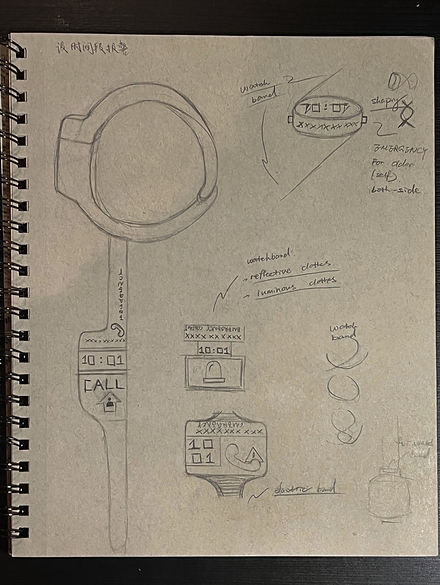
01. Sketch
For the previous sketch, a set of "functional, convenient" objects is the design topic. This set includes the watch with a QR code, a couple of press buttons, and a guidebook.
PURPOSE
Watch--------- for elderlies to wear
QR. code----- to be scanned and be found by others on the street
Buttons------- to be put at home
to call for assistance
Guidebook-- to explain how to use all the objects


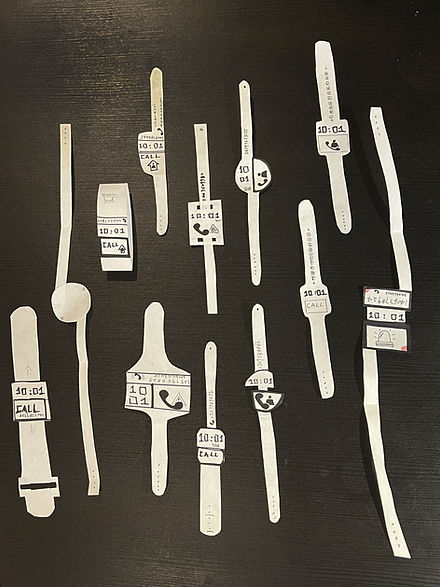
02. Sketch Improve & paper prototype
While making paper prototypes, I found out some problems such as the buttons may be hard to press for Alzheimer's. More models were created to find a better solution
The dissymmetry watch plate was developed since the straight side design is uncomfortable to many people.
03. 3D Prototypes

Laser cutting (wood) watch plate

Clay prototypes and paint the color

Wood and acrylic prototypes

3D printing for different sizes
04. User test
It worked very well on left-hand users but was awkward on right-hand users due to the asymmetrical design.


05. Improve & Test
To satisfy all of the users, I tried making the design to be double-sided. It still was not convenient enough, so I switched back to the symmetrical design but make the surface narrower for comfort.


3D printing prototypes

Right-hand test

Left-hand test
06. Final design

LCD screen
The screen is set on the app, and it has two parts: the clock is designed for the elderly, and the time needs as big as possible; another part is designed for other helpers. This part is upside down with bright color, which is easy to be attended by others.
Volume button
The watchband is full of wholes that can let users move the watch plate at any time in any place. Some elderly would love to wear their watch in the inner waist, and some wear it in the outer waist.
Watchband
The watchband is full of wholes that can let users move the watch plate at any time in any place. Some elderly would love to wear their watch in the inner waist, and some of them wear in outer waist.
Call & Answer button
The user presses the button to call and answer the connector. It is big enough to convenient for all of the inflexible fingers manipulation, and has no complex operation.
.
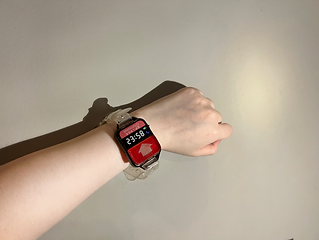
Final test, right hand
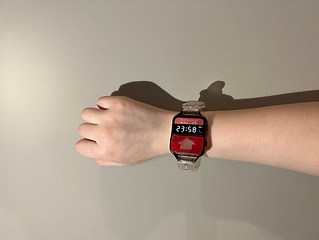
Final test, left hand

Overall appearance

Details of the watch

Watch face
This screen can be set to different colors on the app, based on everyone's color sensitivity and love.

Wear in outer waist
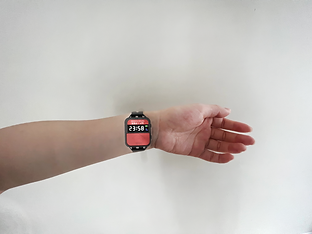
Wear in inner waist

Appearance

Watchband agrafe on the top
07. App UI Design
